
You built something. It works. People are using it. So far, so good.
Are you quietly killing your own runway by charging too little? It’s a decision almost every founder makes: you keep the price low to get traction. Maybe it’s a beta price, a “founding member” rate, or just a gut feeling that a lower price point will get you those first precious customers.
And it worked. People signed up. But now, how to ask for a higher price
The Hidden Cost of Charging Too Little
Now, six months later, you realize you need to raise your price by a lot. And it feels scary. But the real risk isn’t just discomfort—it’s the revenue you might be leaving on the table.
For example, if you had charged even $50 more per customer from the beginning, with 100 active users, that could have meant an extra $5,000 in revenue over just six months. Suddenly, the cost of staying low feels more real than the fear of raising prices.
The reality is, you often need those first customers to help you get funding or work out product issues. But it’s easy to start thinking your first price is your product’s true value. You have to let go of that idea.
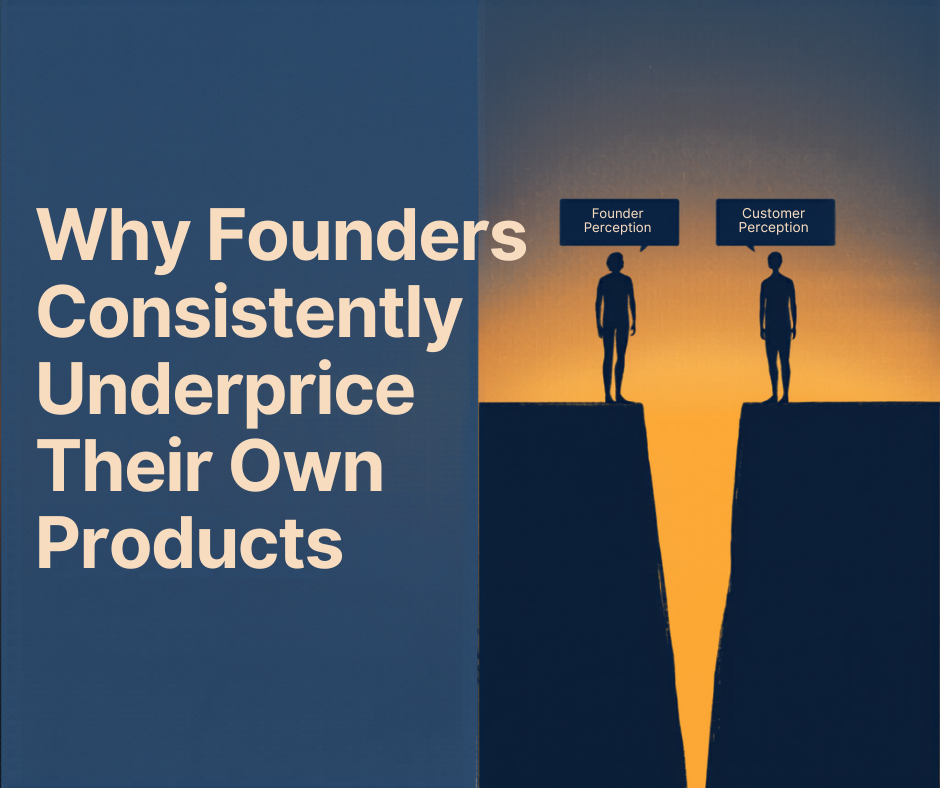
Initial Price: Founders’ Narrative
There’s a psychological pricing strategy at play here that goes beyond tactics. When you’re building something, you know every flaw, every limitation, every corner you cut to ship on time. Your internal dialogue is a highlight reel of everything that still needs fixing. Naturally, your perceived value of the product is lower than what your customer sees as value. It is a mindset until proven otherwise.
This gap between founder perception and customer perception is where bad pricing decisions are born. It’s a well-documented phenomenon known as the anchoring effect: the first price a customer sees becomes their mental reference point, shaping every judgment that follows.
And for products that are genuinely unique, platforms, tools, or services without a clear “category”, the problem gets worse. Without obvious competitors to benchmark against, founders default to underpricing because they don’t have a reference price to anchor to. There’s no “industry standard” to frame around.
If your product is unique, you can’t just copy others’ prices. You need to research the cost of the problem you solve, what alternatives your customers have, and be willing to test, adjust, and set a high starting price. But you need the revenue fast!
What Is a Price Anchor? The Psychology Behind It
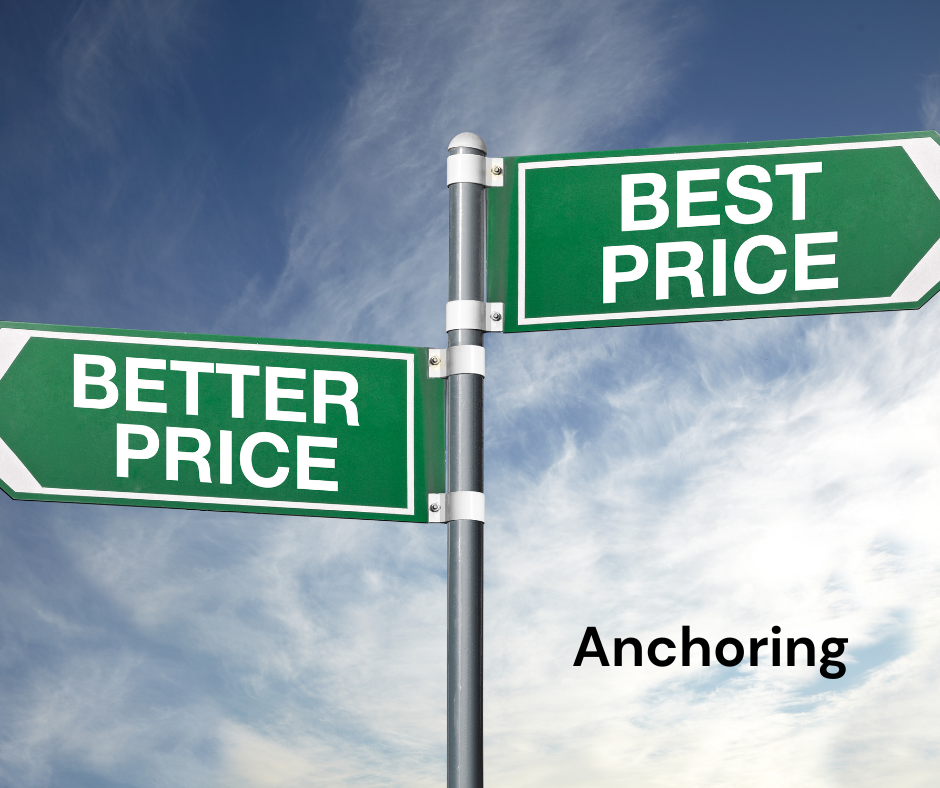
Price anchoring comes from behavioral psychology and has a lot of practical power, even if you’ve never studied sales.
Anchoring means setting a reference price before you share your real offer, so the actual price looks better by comparison. Usually, to get a better price, you point to an existing, significantly higher value so your final price feels reasonable.
“In many situations, people make estimates by starting from an initial value that is adjusted to yield the final answer.”
— Amos Tversky & Daniel Kahneman, 1974
Psychologists Amos Tversky and Daniel Kahneman first documented this idea in 1974. In one of their well-known experiments, they prove that our brains don’t judge things on their own. We compare. We look for a reference point. Whoever sets that first wins the framing game.
The Anchoring Effect
The first price a customer sees becomes their mental reference point, shaping every judgment that follows.
The Framing Game
In sales and marketing, whoever says the number first sets the frame for the whole conversation.
The Comparison Instinct
Our brains don’t judge things on their own. We compare. We look for a reference point.
Use Price Anchoring: When and How It Works
Price anchoring works best when you use it thoughtfully and honestly. It’s about setting the right context before you talk about price. Knowing when anchoring works, and when it doesn’t, is key.
Examples of Price Anchoring in Practice
Here are the moments where price anchoring strategies matter most:
Introducing a New or Higher Price
When you introduce a new price or raise an existing one, anchor to a bigger, familiar number. This makes your price feel more reasonable and helps prospects view the increase as less significant.
Selling to Someone New to the Problem
Set a clear reference price. Doing this gives them a benchmark and makes your offer seem like a smart, informed choice.
When Your Product Is Bundled
Anchor your extra cost to their current spending. This makes your solution seem like an easy, incremental step that blends naturally into their budget.
When Your Product Saves Time or Money
Anchor to the cost of the problem, not just your solution. This shifts the focus from what they pay to what they save, making your price look like a sensible investment.
When a Prospect Is Thinking About Doing Nothing
Anchor to the hidden costs of inaction. This positions your price as the logical next step and makes staying put look riskier than buying.
When Anchoring Doesn’t Work
Anchoring fails if the anchor is clearly unrealistic, if the buyer already knows the market and has their own reference points, or if there’s no clear link between the anchor and your price. For example, I once saw a founder try to anchor enterprise software at $500,000 when similar products sold for $30,000; the prospect immediately lost trust and walked away. A misjudged anchor can backfire and end the conversation before it starts.
But when you use anchoring well and honestly, it can completely change how a prospect reacts to a price they might have rejected. That’s why it’s such a powerful tool for founders.
The $120 Price Anchor: A Real Story

I recently worked with a client who built an e-learning product for institutions that really delivered results. His go-to-market strategy called for a much higher price point, about 200 percent above where he’d been selling.
Before
Average price: $5,000 per institution per year
Average contract value (10 institutions): $50,000
After
Average price: $20,000 per institution per year
Average contract value (10 institutions): $200,000
That single shift meant his average contract value jumped from $50,000 to $200,000 for just 10 institutions. Suddenly, the impact of how you present price is crystal clear.
When I told him the new price, I saw his reaction right away. He got quiet, his jaw tightened, and I could tell he was thinking about losing leads. I’ve seen this many times. Founders hear a higher price and instantly imagine their most price-sensitive customer. Their sense of value shrinks.
“When you present the price, frame it per student. It comes out to less than a dollar per head, on top of the $120 they’re already paying. It’s an insignificant add.”
His next prospect call came a few days later. The new price came up. The prospect didn’t blink. Not even slightly. Discovery, demo, verbal acceptance — all in one sequence.
The anchor was the existing $120 fee, something familiar and already accepted. Our price, compared to that anchor, felt fair. A lower price is much easier to accept when it’s measured against something the buyer already pays for. The difference was framed to their advantage.
For me, that advisory project delivered a 4x ROI in just two weeks. More importantly, it showed my client that his pricing issue wasn’t really about the price. It was about setting the right reference price and letting the anchor do its job.
Why Anchoring Isn’t a Trick: The Science Behind the Strategy
If you’re skeptical, you’re not alone. Many founders worry that anchoring is a sales gimmick, too salesy, but the real story is more interesting. Let’s break down why experts agree that effective price anchoring is driven by psychology—not trickery. Price anchoring is a powerful and well-documented concept. It’s not just a sales trick. The psychology behind it has been studied for decades.
Predictably Irrational — Anchoring Bias in Product Pricing
Ariely’s research at MIT showed that even random numbers can affect how much people are willing to pay. For example, MBA students with higher Social Security numbers bid more for the same items. This is comparative pricing without any logic, but it still works.
He concluded that we think our decisions are rational, but they’re actually shaped by context and reference points. That’s why price anchoring works so well. As a founder, you set the context for your buyer and create the reference price, even if you don’t mean to.
“Humans rarely choose things in absolute terms. We are always looking at things around us in relation to others.” — Dan Ariely, Predictably Irrational
Never Split the Difference — Anchor Strategy in High-Stakes Deals
Voss, a former FBI hostage negotiator, argues that a strong anchor is one of the best tools in tough negotiations. He recommends anchoring high and being very specific. For example, using “$127,400” instead of “$130,000” shows the number was carefully calculated. Being specific builds credibility and strengthens the anchor.
In B2B sales, this means you should anchor to the specific cost of the problem you solve (like, “companies like yours typically lose $80,000 a year to this issue”). Vague anchors are easy to ignore, but specific ones set the baseline for the whole negotiation. That’s how price anchoring works in real life.
“He who controls the anchor controls the deal.” — Chris Voss, Never Split the Difference
Turn These Tactics Into a One-Week Sprint: Anchor Your Price in 3 Steps
You don’t have to be a sales expert to use price anchoring. The fastest way to get started is to schedule these actions across your calendar, so you’re actively building your new pricing habits. Try blocking one tactic per day this week. Here’s a simple road-map founders can use to actually make these moves:
Each of these three steps builds on the last, shifting the conversation from what your product costs to what it’s truly worth.
Step 1: Anchor to the Problem Cost, Not Your Product Cost
Before you name your price, help your prospect articulate — in their own words — what the problem costs them today. Time, money, team frustration, missed revenue. Once they’ve said it out loud, your price is measured against that anchor price. Not against their budget. Not against a competitor.
This is one of the most effective price anchoring techniques precisely because the reference price comes from them. This is how you shift the conversation from price to value.
Step 2: Use an Existing Payment as Your Price Anchor
If your product or service integrates with or complements something a prospect already pays for — software, a licensing fee, a tiered pricing plan — price your product as a fraction of that.
“For less than 10% of what you’re already spending on X, you get…” is a powerful frame.
This is bundle pricing at its most elegant: your product is the best value add-on inside something they already own. Different pricing structures call for different anchor points, but this tactic consistently makes a high price seem more attractive.
Step 3: Tiered Pricing Strategy — Let Your Premium Plan Do the Anchoring
This is one of the most popular price anchoring strategies, used everywhere from SaaS pricing pages to enterprise software. If you have several plans, always show the most complete (and highest-priced) option first. The premium plan becomes the anchor. The other options then feel more reasonable—even affordable—by comparison. The higher price sets the anchor, making the lower tier look like a smart deal.
That’s why SaaS and tiered pricing often start with the “Enterprise” plan. The highest price becomes the reference point. The middle tier suddenly looks like the best value, and the plan seems more appealing because it’s compared to something bigger.
Enterprise Plan
Shown first — becomes the anchor. Sets the reference point for everything below.
Professional Plan
Suddenly looks like the best value. The middle tier feels reasonable by comparison.
Starter Plan
Feels affordable and accessible — because it’s measured against something much bigger.
You can also try different anchor prices across your pricing tiers to see what works best. Comparative pricing, charm pricing (like $997 instead of $1,000), and decoy pricing all help reinforce the anchor and shape how customers see value.
The goal isn’t to trick anyone. It’s to make sure your price is heard in the right context. Price anchoring isn’t about deception—it’s about setting the right reference point. You’ve earned your price. Now help your customer see its value.
A Pricing Strategy That Works: Final Thoughts
Pricing a unique product is one of the toughest choices a founder faces. There’s no formula or benchmark that takes away the uncertainty. The answer is almost never to set a lower price. It’s about building the right frame around the price you deserve.
Powerful
Price anchoring is a powerful, proven, and ethical strategy.
Proven
It’s based on how people really make decisions, documented by decades of research.
Ethical
It shapes how customers see value before they object — used with integrity, it’s a win-win.
Your price anchor isn’t just a number. It’s the first move in every sales conversation you’ll have. Make it matter.
Written by a GTM advisor and sales strategist who helps founders build revenue engines. If this was helpful, share it with a founder who needs encouragement to charge what they’re worth.